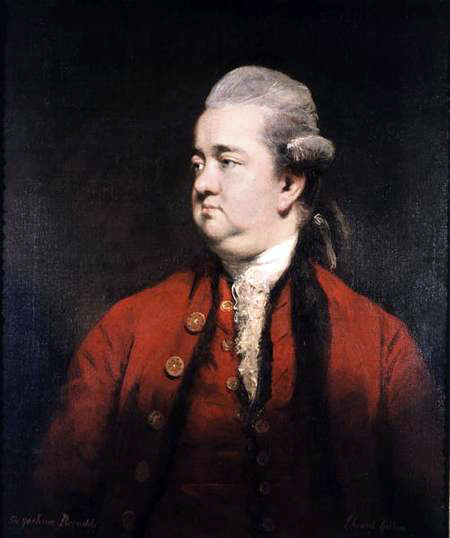
«[...] the greatest English historian, Edward Gibbon. Gibbon was a man of awesome learning and unbending criteria as to what was worth his while to understand in the past. In deciding to be a 'philosophical historian' and not a mere antiquarian, he had decided to draw on the full range of the culture of his age in order to understand the great themes he had proposed himself. Few modern history libraries known to me have yet flanked their collection of historical sources with those shelves upon shelves of works on human geography, of travellers' accounts, of ethnographic monographs on distant tribes and regions which Gibbon mobilized in the footnotes that support the deceptively untroubled flow of his narrative. [...] Now Gibbon was one of the last late classical men. [...]
If Gibbon seems, at first reading, to be different from ourselves, it is because he embarked upon his enterprise with a deeply premeditated criterion of relevance. The iron discipline which enabled him to carry through so great a work was based upon this criterion. It was built up by innumerable acts of renunciation. Volumes could be filled with what Gibbon was in a position to put into the Decline and Fall and yet decided to leave out. [...]Gibbon was the last man to dismiss 'airy beings', once belief in them was woven into society in so solid and intricate a manner. Merciless on Christian metaphysical folly, he is more tolerant than we might think of Christian ceremonial: 'Experience had shewn him [Pope Gregory the Great] the efficacy of these solemn and pompous rites, to soothe the distress, to confirm the faith, to mitigate the fierceness, and to dispel the dark enthusiasm, of the vulgar. . .; For what was visible and concrete, even if it was superstitious, could be controlled and modified. It was the 'folly' that welled up from the isolated intellect that both disgusted and frightened him. The anxieties of the first pagan observers of Christianity were his own: '. . . they supposed that any popular mode of faith and worship which presumed to disclaim the assistance of the senses would, in proportion as it receded from superstition, find itself incapable of restraining the wanderings of the fancy and the vision of fanaticism. The careless glance which men of wit and learning condescended to cast on the Christian served only to confirm their hasty opinion, and to persuade them that the principle, which they might have revered of the Divine Unity, was defaced by the wild enthusiasm, and annihilated by the airy speculations of the new sectaries.' [...]
More is involved in this, however, than Gibbon's attitude toward Christian controversy and Christian otherworldliness. For these were merely paradigms of the more general tension between reality and 'folly' in society as a whole. To be effective, in Gibbon's view, institutions and legal systems had to be firmly swaddled in an integument of 'prejudices' and values. This integument kept them in touch with reality and exposed them to the modifying influence of human contact. Cut it, and the enduring human propensity for 'folly' for vanity, for cruelty, for fanaticism-will be released. Thus, religious and institutional experiences can be congruent: in both a religious and a political system, decline and breakdown take the form of a kind of 'folly', whether this is speculative theology or tyrannical vanity, bursting out of the net of controls in which it had been held. The imperial court, once it had burst its way out of the delicate restraints of the Augustan settlement, came to exist in as great an isolation from the modifying influences of humane society as did anyChristian hermit. [...]
Let us examine aspects of Gibbon's attitude to the irruption of 'folly' in the flfth- and sixth-century Roman world in terms of this 'leakage of reality'. First, let us consider the religious evolution of the period. In this, Gibbon is the heir of a long tradition. We still share his problem. The rise of the Christian Church is the story of the rise to great power in this world of an institution whose basis was a claim to be interested only in the other world. By Gibbon's time, however, the problem had changed. What to later medieval and Reformation thinkers had appeared as a religious and moral incongruity had become a problem strictly of religious and cultural history. For not only could the Christian Church be said to have abandoned its otherworldly vocation, it had actually risen to greater and greater power by inflating belief in the other world. [...]
Once again, the studied ambiguity of Gibbon's attitude to the tissue of society enabled Gibbon to place the new court life of the age, as he placed the Christian Church, on parole. It was not inevitable that the balance should tilt irreversiblytoward the mere show against the substance of power. Hence the vital importance for Gibbon of Constantine. In the Decline and Fall, it is not Constantine the convert of the Milvian Bridge who holds the centre of the stage, it is Constantine the victorious autocrat of the period after 324. The reign of Constantine emerges as of crucial significance in the history of the formation of late Roman absolutism: for with Constantine the balance shifted from role-playing to fantasy. This, and not his relations with the Christian Church, is what gives Constantine his place in the Decline and Fall. 'Diocletian was a man of sense, who, in the course of private aswell as public life, had formed a just estimate both of himself and of mankind: nor is it easy to conceive that, in substituting the manners of Persia to those of Rome, he was seriously actuated by so mean a principle as that of vanity.' Constantine,however, was spun into the illusion which his great predecessor had manipulated: 'The Asiatic pomp, which had been adopted by the pride of Diocletian, assumed an air of soft effeminacy in the person of Constantine.' 'In the life of Augustus, we behold the tyrant of the republic converted, almost by imperceptible degrees, into the father of his country and of humankind. In that of Constantine, we may contemplate a hero, who had long inspired his subjects with love and his enemies with terror, degenerating into a cruel and dissolute monarch, corrupted by his fortune or raised by conquest above the necessity of dissimulation.' [...]
Byzantine society is repugnant to Gibbon less through any reputed limitation in his sympathies and knowledge than precisely because he saw with singular clarity the most obtrusive feature of that society as it was faithfully reflected in the historical sources available to him. It was the Byzantine historiographical tradition itself, often the work of courtiers or of writers who purveyed court slander, that betrayed Byzantium to this regular and critical attendant at the stage play of autocracy. Byzantium, a society of monks and courtiers, represented the final weakening, on both the religious and the institutional plane, of the merciful restraints of civilizedsociety. The development of the Holy Roman Empire, by contrast, poignantly illustrated the other aspect of this process of depletion. The 'leakage of reality' reaches its height at the imperial court of Charles IV of Bohemia: 'If we annihilatethe interval of time and space between Augustus and Charles, strong will be the contrast between the two Caesars: the Bohemian, who concealed his weakness under the mask of ostentation, and the Roman, who disguised his strength under the semblance of modesty.'»

Society and the Holy in Late Antiquity
[Η Κοινωνία και το Άγιο στην Ύστερη Αρχαιότητα],
University of California Press, 1982,
pp./σσ. 20, 24, 30-33, 41, 43.


