.

Showing posts with label ΣΥΝΟΔΟΙ ΕΚΚΛ.. Show all posts

Tuesday, October 4, 2022

Theodore of Mopsuestia
on John 20:28 /

Ο Θεόδωρος Μοψουεστίας
περί του Ιωάννης 20:28


Οὗτος δὲ καὶ τὴν ὁμολογίαν Θωμᾶ τὴν ἐπὶ τῇ ψηλαφήσει τῶν χειρῶν καὶ τῆς πλευρᾶς τοῦ κυρίου μετὰ τὴν ἀνάστασιν τό «ὁ κύριός μου καὶ ὁ θεός μου», εἶπε μὴ εἰρῆσθαι περὶ τοῦ Χριστοῦ παρὰ τοῦ Θωμᾶ (οὐδὲ γὰρ αὐτὸν εἶναι λέγει τὸν Χριστὸν θεόν), ἀλλ’ ἐπὶ τῷ παραδόξῳ τῆς ἀναστάσεως ἐκπλαγέντα τὸν Θωμᾶν ὑμνῆσαι τὸν θεὸν τὸν ἐγείραντα τὸν Χριστόν.

--Concilia Oecumenica (ACO), Concilium Lateranense a. 649 celebratum, act 4, p. 230.


"Similarly, that the confession of Thomas, on touching the hands and the side of the Lord after the resurrection, “My Lord and my God,” was not spoken concerning Christ by Thomas (and neither he says that Christ is god), but that, astonished at the miracle of the resurrection, Thomas praised God who raised Christ."

Thursday, July 23, 2020

Wednesday, April 25, 2012

The record of the Church
towards the Jews:
A long prelude to the Holocaust /

Το υπόμνημα της Εκκλησίας
έναντι των Εβραίων:
Ένα μακρύ πρελούδιο προς το Ολοκαύτωμα


Hitler Youth cross /
Σταυρός της χιτλερικής νεολαίας


p./σ. 203


Canonical Law

Nazi Measure

Prohibition of intermarriage and of sexual intercourse between Christians and Jews, Synod of Elvira, A.D. 306.

Law for the Protection of German Blood and Honor, September 15, 1935 (RGB1 I, 1146).

Jews and Christians not permitted to eat together, Synod of Elvira, 306.

Jews barred from dining cars (Transport Minister to Interior Minister, December 30, 1939, Document NG-3995).

Jews not allowed to hold public office, Synod of Clermont, 535.

Law for the Reestablishment of the Professional Civil Service, April 7, 1933 (RGB1 I, 175).

Jews not allowed to employ Christian servants or possess Christian slaves, third Synod of Orleans, 538.

Law for the Protection of German Blood and Honor, September 15, 1935 (RGB1 I, 1146).

Jews not permitted to show themselves in the streets during Passion Week, third Synod of Orleans, 538.

Decree authorizing local authorities to bar Jews from the streets on certain days (i.e., Nazi holidays), December 3, 1933 (RGB1 I, 1676).

Burning of the Talmud and other books, 12th Synod of Toledo, 681.

Book burnings in Nazi Germany.

Christians not permitted to patronize Jewish doctors, Trulanic Synod, 692.

Decree of July 25, 1938 (RGB1, I, 969).

Christians not permitted to live in Jewish homes, Synod of Narbonne, 1050.

Directive by Göring providing for concen­tration of Jews in houses, December 28, 1938 (Bormann to Rosenberg, January 17, 1939, PS-69).

Jews obliged to pay taxes for support of church to the same extent as Christians, Synod of Gerona, 1078.

The “Sozialausgleichsabgabe” which pro­vided that Jews pay a special income tax in lieu of donations for Party purposes im­posed on Nazis, December 24, 1940 (RGB1 I, 1666).

Prohibition of Sunday work, Synod of Szabolcs, 1092.

N/A.

Jews not permitted to be plaintiffs, or witnesses against Christians in the courts, 3rd Lateran Council, 1179, Canon 26.

Proposal by the Party Chancellery that Jews not be permitted to institute civil suits, September 9, 1942 (Bormann to Justice Ministry, September 9, 1942, (NG-151).

Jews not permitted to withhold inheritance from descendants who accepted Christian­ity, 3rd Lateran Council, 1179, Canon 26.

Decree empowering the Justice Ministry to void wills offending the “sound judgment of the people,” July 31, 1938 (RGB1 I, 547).

The marking of Jewish clothes with a badge, 4th Lateran Council, 1215, Canon 68. (Copied from the legislation by Caliph Omar II [634-44], who had decreed that Christians wear blue belts and Jews, yellow belts.)

Decree of September 1, 1941 (RGB1 I, 547).

Construction of new synagogues prohib­ited, Council of Oxford, 1222.

Destruction of synagogues in entire Reich, November 10, 1938 (Heydrich to Göring, November 11, 1938, PS-3058).

Christians not permitted to attend Jewish ceremonies, Synod of Vienna, 1267.

Friendly relations with Jews prohibited, October 24, 1941 (Gestapo directive, L-15).

Jews not permitted to dispute with simple Christian people about the tenets of the Catholic religion, Synod of Vienna, 1267.

N/A.

Compulsory ghettoes, Synod of Breslau, 1267.

Order by Heydrich, September 21, 1939 (PS-3363).


Christians not permitted to sell or rent real estate to Jews, Synod of Ofen, 1279.

Decree providing for compulsory sale of Jewish real estate, December 3, 1938 (RGB1 I, 1709).

Adoption by a Christian of the Jewish religion or return by a baptized Jew to the Jewish religion defined as a heresy, Synod of Mainz, 1310.

Adoption by a Christian of the Jewish religion places him in jeopardy of being treated as a Jew. Decision by Oberlandes­gericht Königsberg, 4th Zivilsenat, June 26, 1942 (Die Judenfrage [Vertrauliche Beilage], November 1, 1942, pp. 82-83).

Sale or transfer of church articles to Jews prohibited, Synod of Lavour, 1368.

N/A.

Jews not permitted to act as agents in the conclusion of contracts between Christians, especially marriage contracts, Council of Basel, 1434, Sessio XIX.

Decree of July 6, 1938, providing for liquidation of Jewish real estate agencies, brokerage agencies, and marriage agencies catering to non-Jews (RGB1 I, 823).

Jews not permitted to obtain academic degrees, Council of Basel, 1434, Sessio XIX.

Law against Overcrowding of German Schools and Universities, April 25, 1933 (RGB1 I, 225).


* William Nicholls,
Christian Antisemitism, A History of Hate
[Χριστιανικός Αντισημιτισμός: Μια Ιστορία Μίσους],
Northvale, NJ: publ. J. Aronson, 1993,
pp./σσ. 204-206.

Saturday, November 26, 2011

Επιβολή συγκεκριμένων θεολογικών θέσεων
μέσω σύγκλησης γενικών εκκλησιαστικών συνόδων /

Enforcing particular theological views
by summoning general Councils of the Church


Η γενική μου θέση είναι πως η Σύνοδος της Χαλκηδόνος ήταν εξίσου μηχανισμός καταστολής όσο και η Δεύτερη Έφεσος (η λεγόμενη Ληστρική Σύνοδος), και μάλιστα ότι ο μηχανισμός ήταν πολύ πιο ισχυρός στη Χαλκηδόνα, τόσο που δεν χρειάστηκε να ασκηθεί πραγματική βία ή έστω να υπάρξει εμφανής απειλή βίας, διότι ο καθένας γνώριζε ότι η αντίσταση στην αυτοκρατορική θέληση θα κατέληγε στην καταστροφή του: απώλεια του επισκοπικού αξιώματος, αφορισμό, και ίσως εξορία σε έναν απομακρυσμένο τόπο της αυτοκρατορίας. Αυτό δεν θα έπρεπε να εκπλήσσει κανέναν, διότι αποτελεί  απλώς ένα από τα πολλά παραδείγματα τού άκρως εκτεταμένου ελέγχου που μπορούσε να ασκήσει ένας ρωμαίος αυτοκράτορας (αν το επιθυμούσε) επί των χριστιανικών εκκλησιών, στην περιοχή πού διοικούσε, ακόμη και στη σφαίρα του δόγματος. Εάν ένας αυτοκράτορας επιθυμούσε να επιβάλει ένα συγκεκριμένο σύστημα θεολογικών απόψεων, μπορούσε να το επιτύχει συγκαλώντας μια γενική σύνοδο της Εκκλησίας, πράγμα που μόνο αυτός είχε δικαίωμα να το κάνει. Ακόμη και ο πάπας Λέων ο Μέγας, ο οποίος είχε την πιο μεγάλη ιδέα για τη σημασία της Αποστολικής Έδρας, αναγκάστηκε να παραδεχτεί, στην αλληλογραφία του με τον Θεοδόσιο Β', με την Πουλχερία και τον Μαρκιανό, ότι ο αυτοκράτορας και μόνο αυτός αποφάσιζε εάν, πότε και πού θα συγκαλούσε γενική σύνοδο. Ο Λέων άλλαξε αρκετές φορές γνώμη σχετικά με τη σκοπιμότητα μιας γενικής συνόδου υπό τις συνθήκες του 449-51, χωρίς όμως να μπορέσει να επιβάλει την άποψή του. Στο τέλος αναγκάστηκε να αρκεστεί με την υιοθέτηση από τη Χαλκηδόνα της δογματικής επιστολής του προς τον Φλαβιανό, γνωστής ως «Τόμος του Λέοντα» και ως καλύτερης διακήρυξης Αληθινής Πίστης. Αναθέτοντας τον έλεγχο της συνόδου στα κατάλληλα πρόσωπα, ένας αυτοκράτορας μπορούσε να επιτύχει τις αποφάσεις που ήθελε. Βέβαια, ίσως να μην μπορούσε να επιβάλει κατόπιν τη δική του εκδοχή για το χριστιανισμό σε όλες τις κτήσεις του. Η Σύνοδος της Χαλκηδόνος, η οποία αυτή καθαυτήν μπορεί να φαίνεται ως ένας απόλυτος θρίαμβος και επαινείται αφειδώς από πολλούς σύγχρονους θεολόγους, έχει συχνά περιγραφεί (ορθώς, κατά την άποψή μου) ως καταστροφή για την Ανατολική Αυτοκρατορία. Όπως το έθεσε ο Norman Baynes, η Χαλκηδόνα συγκλήθηκε «όχι για να φέρει την ειρήνη, άλλα το σπαθί». Ο μονοφυσιτισμός ήταν πολύ ισχυρός για να καταπνιγεί σε ορισμένες περιοχές, κυρίως στην Αίγυπτο, καθώς και σε τμήματα της Συρίας και της Μεσοποταμίας· οι ορθόδοξοι αυτοκράτορες όφειλαν ασφαλώς να μείνουν ικανοποιημένοι με δογματικές διατυπώσεις που θα τον είχαν ενσωματώσει, ή τουλάχιστον θα ανέχονταν την ύπαρξή του. Σχεδόν όλοι όμως οι επίσκοποι επιθυμούσαν διακαώς να εξαλείψουν αυτό πού θεωρούσαν αίρεση.

* Geoffrey de Ste Croix,
Ο χριστιανισμός και η Ρώμη. Διωγμοί, αιρέσεις και ήθη,
Μετάφρ. Ιωάννα Κράλλη,
Αθήνα 2005, 1η ανατύπωση 2010,
σσ. 328-330.


My overall thesis is that the Council of Chalcedon was every bit as much an engine of coercion as the ‘Robber’ Council of Second Ephesus, and that the machinery of compulsion was actually far more powerful at Chalcedon, so much so that actual force did not need to be used, or even visibly threatened, because everyone knew that resistance to the imperial will would result in his ruin: the loss of episcopal office, and perhaps excommunication and exile to a distant part of the empire, as happened to the one determined opponent, Dioscorus. This should not surprise anyone, as it only provides one more among many examples of the very high degree of control that a Roman emperor could exercise (if he wished) over the Christian churches in the area over which he ruled, even in the sphere of doctrine. It was easiest to enforce a particular set of theological views by summoning a general Council of the Church, which the emperor alone had the power to do. Even Pope Leo the Great, who had the most exalted idea of the importance of his own Apostolic See, had to admit throughout his correspondence with Theodosius II, Pulcheria, and Marcian, which fortunately survives, that it was the emperor and the emperor alone who decided whether, when, and where to summon a general council. Leo changed his own view about the desirability of a general council more than once between 449 and 451 in the light of changing circumstances, but was unable to impose his wishes. In the end he had to be content with having his doctrinal letter to Flavian of Constantinople, which is commonly referred to as the Tome of Leo, endorsed at Chalcedon as the best statement of the true faith. [...]

It was only by placing control of a council in the right hands that an emperor could be certain of securing the decisions that he wanted: even an emperor’s representative might be outmanoeuvred if he was not presiding. [...]

The Council of Chalcedon, which in isolation can be seen as a complete triumph for Marcian and Two Nature Christology, and which has been lavishly praised by some modern theologians, has often been described, rightly in my opinion, as a disaster for the Eastern Empire: as Norman Baynes put it, Chalcedon came ‘not to bring peace, but a sword’. Monophysite views were far too strong to be suppressed in some areas, above all in Egypt and much of Syria and Mesopotamia, and the Orthodox Empire would surely have done better to be content with doctrinal formulae that would have accommodated it, or at least tolerated its existence. [...]

It is true that most bishops whose voices can be heard wanted to be on record as deeply committed to stamping out what was identified as heresy, but that should come as no surprise.


* Geoffrey de Ste Croix,
edited by Michael Whitby & Joseph Streeter,
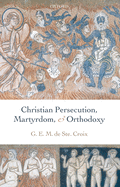
Christian Persecution, Martyrdom, and Orthodoxy
[Χριστιανικός Διωγμός, Μαρτύριο και Ορθοδοξία],
pp. 274, 275, 319, 281.

Saturday, June 25, 2011

A reason for the "orthodoxy" & "heresy" disputes
since the 3rd century CE /

Ένας λόγος για τις διαμάχες «ορθοδοξίας» & «αίρεσης»
από τον 3ο αιώνα Κ.Χ. κι έπειτα


The fathers of the Church, particularly Origen (c. 185-253), a school-fellow of Plotinus the founder of Neoplatonism, set about incorporating the safer parts of ancient philosophy into Christian dogma. Much of it had already found its place there unconsciously. The task was nevertheless difficult, partly owing to the very different philosophy which underlies the Old Testament. Inevitably it led to controversies in which each side claimed to be orthodox and accused the other of heresy. The great disputes and heresies of the fourth and fifth centuries which split Eastern Christianity, those of the Arians, the Nestorians, and the Monophysites, were largely on points of interpretation of Neoplatonist ideas of the nature of the soul and its relation to corruptible or incorruptible bodies.

These disputes were nominally settled by Councils of Bishops, implying a basic democracy in the Church, but usually the decision went in favour of the side that could win over the Emperor. The great Arian heresy of the fourth century on the nature of the Godhead was settled in this way at the Council of Nicaea in 325. There Athanasius imposed his implacable Trinitarian creed. Its triumph was not assured, however, until almost two centuries later when Justinian had defeated the Arian Goths.

By the fifth century a compromise between faith and philosophy was worked out by St Augustine (354-430), who produced a kind of composite between scriptural tradition and Platonism, with a strong flavour of predestination, derived from his Manichean experience, which was to dog Christianity and particularly Puritanism ever afterwards. This included the essentially Zoroastrian idea of the cosmic conflict of good and evil (Ormuzd and Ariman) with its associated ideas of the Devil and Hell-fire. The Augustinian compromise did not last; heresy followed heresy, and the work of suppressing them had to be done all over again in the Middle Ages, and ultimately failed altogether in the Reformation.


Οι πατέρες της Εκκλησίας, και ειδικότερα ο Ωριγένης (περ. 185-253), συμμαθητής του Πλωτίνου του ιδρυτή του νεοπλατωνισμού, ξεκίνησε την ενσωμάτωση των ασφαλέστερων τμημάτων της αρχαίας φιλοσοφίας στο χριστιανικό δόγμα. Αυτό συνέβη κατά το μεγαλύτερο μέρος του ασυναίσθητα. Εντούτοις, το έργο αυτό ήταν δύσκολο, ενμέρει λόγω της πολύ διαφορετικής φιλοσοφίας η οποία ενυπάρχει στην Παλαιά Διαθήκη. Αναπόφευκτα οδήγησε σε διενέξεις κατά τις οποίες η κάθε πλευρά ισχυριζόταν ότι ήταν ορθόδοξη και κατηγορούσε την άλλη για αίρεση. Οι μεγάλες διενέξεις και αιρέσεις του τέταρτου και του πέμπτου αιώνα που διαίρεσαν τον ανατολικό χριστιανισμό, αυτές των Αρειανών, των Νεστοριανών και των Μονοφυσιτών, ήταν κατά κύριο λόγο σχετικά με σημεία ερμηνείας των νεοπλατωνικών ιδεών περί της φύσης και της σχέσης της με τα φθαρτά ή τα άφθαρτα σώματα.

Οι διενέξεις θεωρητικά επιλύονταν από Συνόδους Επισκόπων, γεγονός που υπονοεί μια βασική δημοκρατία εντός της Εκκλησίας, αλλά συνήθως η απόφαση λαμβανόταν υπέρ της πλευράς που κέρδιζε με το μέρος της τον αυτοκράτορα. Η μεγάλη αρειανική αίρεση του τέταρτου αιώνα περί της φύσης της Θεότητας επιλύθηκε με αυτό τον τρόπο στη Σύνοδο της Νίκαιας το 325. Εκεί ο Αθανάσιος επέβαλε το αμείλικτο τριαδικό σύμβολο πίστης του. Ο θρίαμβος του δεν κατοχυρώθηκε, όμως, παρά μόνο δύο αιώνες αργότερα όταν ο Ιουστινιανός νίκησε τους αρειανούς Γότθους.

Ως τον πέμπτο αιώνα έναν συμβιβασμό μεταξύ πίστης και φιλοσοφίας απεργάστηκε ο Αγ. Αυγουστίνος (354-430), ο οποίος παρήγαγε κάποιου είδους σύνθεση μεταξύ Γραφικής παράδοσης και πλατωνισμού, με μια ισχυρή δόση προκαθορισμού προερχόμενου από την μανιχαϊκή του εμπειρία, η οποία επρόκειτο έκτοτε να ακολουθεί αδιάκοπα τον χριστιανισμό και ειδικότερα τον πουριτανισμό. Περιλάμβανε την κατ' ουσίαν ζωροαστρική ιδέα της κοσμικής διαμάχης του καλού με το κακό (του Ωρομάσδη και του Αριμάν) με τις σχετιζόμενες ιδέες του Διαβόλου και της φωτιάς της Κόλασης. Ο αυγουστίνειος συμβιβασμός δεν κράτησε πολύ· οι αιρέσεις ακολουθούσαν η μία μετά την άλλη και το έργο της καταστολής τους έπρεπε να επαναλαμβάνεται κατά τον Μεσαίωνα και τελικά απέτυχε ολοκληρωτικά με την Μεταρρύθμιση.

* J. D. Bernal,
Science in History,
Volume 1: The Emergence of Science
,
Faber & Faber 2010 (Penguin 1969),
p./σ. 260.

Thursday, May 19, 2011

Οι περί ηθικής συνοδικοί κανόνες,
η χαλιναγώγηση της σεξουαλικής ηδονής
& η θρησκειοποίηση του εκκλησιαστικού γεγονότος
κατά τον Χρήστο Γιανναρά


Η θρησκειοποίηση μοιάζει να διαπλέκεται πολλές φορές δυσδιάκριτα με το εκκλησιαστικό φρόνημα, ακόμα και στα έργα Πατέρων και διδασκάλων της Χριστιανοσύνης, αλλά και στην υμνολογία, ευρύτερα στη λατρεία, στη λειτουργία των διοικητικών θεσμών, στην ασκητική πρακτική, στη λαϊκή ευσέβεια. Και διαιωνίζει, κατά κανόνα, τα χαρακτηριστικά γνωρίσματα των απαιτήσεων που πρώτοι, προέβαλαν στον εκκλησιαστικό βίο οι Ιουδαΐζοντες: Την ανάγκη Νόμου (: κωδικοποιημένων εντολών, διαβάθμισης ενοχών, προκαθορισμού ποινών για «εξαγορά» της ατομικής «δικαίωσης»). Την ανάγκη εξωτερικών τύπων που να αντικειμενοποιούν αισθητά (όπως η περιτομή) το δεδομένο ότι το άτομο ανήκει στη χριστιανική συλλογικότητα. Την ανάγκη χαλιναγώγησης της σεξουαλικής ηδονής, ανάγκη που επιθετικά εκφράζει η περιτομή.

Γίνεται ευδιάκριτη η διαπλοκή της θρησκειοποίησης με το εκκλησιαστικό φρόνημα κυρίως από τα τέλη του 7ου πια αιώνα, όταν, όπως ήδη αναφέραμε, θεσμοποιείται από τη λεγόμενη Πενθέκτη Οικουμενική Σύνοδο η καθολική επιβολή «Κανόνων» ρυθμιστικών του ατομικού βίου των Χριστιανών.

Και το πρόβλημα δεν είναι ο παράλογα στυγνός ηθικισμός κάποιων κανόνων (σύμφωνα με τα όσα αυτοί οι κανόνες ορίζουν και που ισχύουν φυσικά ως σήμερα, το σύνολο σχεδόν των επί γης Χριστιανών υπόκειται σε αφορισμό). Το οδυνηρότερο πρόβλημα είναι η σύγχυση που δημιουργείται γύρω από την έννοια της αμαρτίας: Η αμαρτία, όπως την προϋποθέτουν οι θρησκευτικής νοοτροπίας κανόνες, δεν έχει σχέση με την αποτυχία του ανθρώπου να εγκεντρισθεί στο ευχαριστιακό ήθος της Εκκλησίας, την υπαρκτική αστοχία του. Δεν είναι η αμαρτία αφορμή για την αυτοπαράδοση στη Χάρη, για τον θρίαμβο της αγάπης του Θεού, για τη φανέρωση της Εκκλησίας ως μυστηρίου Σταυρού και Ανάστασης. Η αμαρτία είναι παράβαση νόμου, αντικειμενικό παράπτωμα, υπάγεται σε διάταξη που την προβλέπει επακριβώς και την τιμωρεί με προκαθορισμένο επιτίμιο.

Και μόνον ο όρος Κανονικό Δίκαιο (μεθοδικά αρθρωμένο δικαιικό σύστημα κανονιστικών διατάξεων που καλύπτουν ευρύτατη περιπτωσιολογία παραβατικής συμπεριφοράς) φανερώνει αναποδογυρισμένες τις προϋποθέσεις του εκκλησιαστικού γεγονότος. Οι κανόνες που αφορούν στον ατομικό βίο των πιστών και η συστηματοποίησή τους βεβαιώνουν τη διαπίστωση πως η θρησκειοποίηση παρακολουθεί τον εκκλησιαστικό βίο από την εποχή των Ιουδαϊζόντων της Καινής Διαθήκης ως σήμερα. Νόμο και περιτομή απαιτούσαν οι Ιουδαΐζοντες, νομικό σύστημα κανονιστικών διατάξεων και, μέσω των κανόνων, επιθετική χαλιναγώγηση της σεξουαλικής ήδονης προσφέρει εξακολουθητικά η θεσμοποιημένη θρησκειοποίηση.


(3η έκδ.), εκδ. Ίκαρος, 2007,
σσ. 210-212.

Saturday, February 26, 2011

The first Council of Nicaea
& the later reconstructive representations of it /

Η πρώτη Σύνοδος της Νίκαιας
& οι μεταγενέστερες ανασκευαστικές περιγραφές της


The documentation of councils—as sites of public debate—not only displaced the actual events after the fact but also contributed to the cramped style of the deliberations themselves: "The dynamics of public debate were altered dramatically when one could be held responsible for everything one said in the heat of discussion." Interestingly, the Council of Nicaea, which inaugurated the history of the authoritative "ecumenical" councils, lacks written acta. The high level of dissension that gave rise to a council later reputed for its unity, Lim points out, may have "rendered a set of acta unnecessary and undesirable." He goes on to discuss the late-fourth- and early-fifth-century literary representations of the Nicene council, which in the final event made such acta doubly superfluous. "The death of Athanasius, who attended the council as a young priest at the side of his bishop Alexander, marked the advent of the post-Nicene age. With all eye-witnesses dead, legends about Nicaea began to emerge." Did the end of Athanasius's eye-witnessing, however, really mark the beginning of "legends about Nicaea"? It seems equally important to point out that Athanasiuss death marked the end of a crucial phase in the literary invention of Nicaea, and that, furthermore, the layered inscription of his "historical" or "apologetic" texts—resulting in his retroactive construction of a virtual archive for the council—contributed heavily to the creation of a documentary habit that was, as Lim and others have demonstrated, crucial to the success of the late-antique council in producing "consensual" orthodoxy.


* Virginia Burrus,
‘Begotten, not made’: Conceiving manhood in late antiquity
[‘Γεννηθείς και όχι ποιηθείς’: Η σύλληψη της ανθρωπινότητας στην ύστερη αρχαιότητα],
Stanford University Press, 2000,
p./σ. 59.


Tuesday, April 27, 2010

Μητρ. Μενεβίσογλου:
Ο εορτασμός του Πάσχα από την Ορθόδοξη εκκλησία & οι αποφάσεις της Πρώτης Συνόδου της Νίκαιας /
Metrop. Bishop Menevisoglou:
Easter celebration by the Greek Orthodox church & the resolutions of the First Council of Nicea


«Κατά ταύτα, ο κανών ή ο «όρος» τής εν Νικαία συνελθούσης πρώτης οικουμενικής συνόδου περί του αγίου Πάσχα διελάμβανε λίαν πιθανώς, τα ακόλουθα: Έδοξε τη αγία και μεγάλη συνόδω όπως η αγία εορτή του σωτηριώδους Πάσχα τελήται υπό πάντων εν μια και τη αυτή ημέρα, ήτοι την Κυριακήν, ήτις ακολουθεί την πρώτην πανσέληνον μετά την εαρινήν ισημερίαν (ή την πανσέληνον την συμπίπτουσαν κατά την ημέραν της εαρινής ισημερίας).

Ατυχώς, παρά τας ώς άνω σαφείς και συγκεκριμένας αποφάσεις τής εν Νικαία πρώτης οικουμενικής συνόδου, το άγιον Πάσχα δεν εορτάζεται (από του έτους 1582) πάντοτε καί υπό πάντων εν «μια και τη αυτή ημέρα». H νέα αύτη ασυμφωνία προέρχεται:

α) εκ του γεγονότος ότι η Ορθόδοξος Εκκλησία καθορίζει την εαρινήν ισημερίαν (21 Μαρτίου), επί τη βάσει του ιουλιανού ημερολογίου (3 Απριλίου τού εν χρήσει ημερολογίου), ενώ από του έτους 1582 αι δυτικαί εκκλησίαι καθορίζουν την εαρινήν ισημερίαν (21 Μαρτίου) επί τη βάσει του γρηγοριανού ημερολογίου (21 Μαρτίου τού έν χρήσει ημερολογίου), και

β) εκ του γεγονότος ότι η Ορθόδοξος Εκκλησία καθορίζει την πανσέληνον του Πάσχα επί τη βάσει του «κύκλου του Μέτωνος» (του «κύκλου της σελήνης»), όστις λόγω συσσορευθείσης διαφοράς εκ της αστρονομικής πραγματικότητος, ορίζει (σήμερον) τας πανσελήνους κατά 5 ημέρας βραδύτερον των αληθών, ενώ αι δυτικαί εκκλησίαι χρησιμοποιούν μεν τον αυτόν «κύκλον του Μέτωνος», αλλά με ωρισμένας διορθώσεις, αίτινες τον κατέστησαν ακριβέστερον αστρονομικώς.

Εν τούτοις είναι προτιμότερον, όπως η Ορθόδοξος Εκκλησία εορτάζη το άγιον Πάσχα εις άλλην από άλλας εκκλησίας ημέραν, εν παραβάσει πολλάκις των σχετικών αποφάσεων τής εν Νικαία πρώτης οικουμενικής συνόδου, διατηρή όμως την ενότητα αυτής εν τω εορτασμώ του Πάσχα, παρά να προκληθή «λειτουργική διάσπασις» και να δημιουργηθούν «νέαι έριδες, σκάνδαλα και σχίσματα εις τους κόλπους της Ορθοδόξου Εκκλησίας», δεδομένου ότι «ού τοσούτον κατόρθωμα, από της των χρόνων ακριβείας», «όσον έγκλημα, από της διαιρέσεως και του σχίσματος»».


* Παύλος Μενεβίσογλου [μητροπολίτης],
Ιστορική εισαγωγή εις τους κανόνας της Ορθοδόξου Εκκλησίας,
εκδ. Ιεράς Μητροπόλεως Σουηδίας και πάσης Σκανδιναβίας, Στοκχόλμη 1990, σσ. 164-166.

Tuesday, April 13, 2010

Μέσα 4ου αιώνα: Τι διαβαζόταν ως κανονικές Γραφές στη Φρυγία της Μικράς Ασίας /
Mid-4th century: What was read as authorised Scriptures at Phrygia, Asia Minor


Old illustration of a Phrygian tomb excavated in the rock,
near Harmancik, Marmara region, Turkey.
Created by Gaiaud, published on Le Tour du Monde, Paris, 1864


Κανὼν νθ' (59):
Ἰδιωτικοὶ ψαλμοὶ οὐ λέγονται ἐπ' ἐκκλησίας, ἀλλὰ μόνον τὰ κανονικά.
Ὅτι οὐ δεῖ ἰδιωτικοὺς ψαλμοὺς λέγεσθαι ἐν τῇ ἐκκλησίᾳ, οὐδὲ ἀκανόνιστα βιβλία, ἀλλὰ μόνα τὰ κανονικὰ τῆς Παλαιᾶς καὶ Καινῆς Διαθήκης.
Κανὼν ξ’ (60):
Ὅσα δεῖ τῶν τῆς Γραφῆς ἀναγινώσκεσθαι βιβλία.
Ὅσα δεῖ βιβλία ἀναγινώσκεσθαι τῆς Παλαιᾶς Διαθήκης· α΄ Γένεσις κόσμου· β΄ Ἔξοδος ἐξ Αἰγύπτου· γ΄ Λευϊτικόν· δ΄ Ἀριθμοί· ε΄ Δευτερονόμιον· στ΄ ᾽Ιησοῦς τοῦ Ναυῆ· ζ΄ Κριταί, Ρούθ· η΄ Ἐσθήρ· θ΄ Βασιλειῶν πρώτη καὶ δευτέρα· ι΄ Βασιλειῶν τρίτη καὶ τετάρτη· ια΄ Παραλειπομένων πρῶτον καὶ δεύτερον· ιβ΄ Ἔσδρας πρῶτον καὶ δεύτερον· ιγ΄ Βίβλος Ψαλμῶν ρν ΄ ιδ΄ Παροιμίαι Σολομῶντος· ιε΄ Ἐκκλησιαστής· ιστ΄ Ἆσμα ἀσμάτων· ιζ΄ Ἰώβ· ιη΄ Δωδεκαπρόφητον· ιθ΄ Ἡσαΐας, Ἱερεμίας καὶ Βαρούχ, Θρῆνοι καὶ Ἐπιστολαί· κα' Ἰεζεκιήλ· κβ' Δανιήλ.

Τὰ δὲ τῆς Καινῆς Διαθήκης ταῦτα· Εὐαγγέλια τέσσερα, κατὰ Ματθαῖον, κατὰ Μᾶρκον, κατὰ Λουκᾶν, κατὰ Ἰωάννην· Πράξεις, Ἀποστόλων· Ἐπιστολαὶ καθολικαὶ ἑπτά, Ἰακώβου μία, Πέτρου δύο, Ἰωάννου τρεῖς, Ἰούδα μία· Ἐπιστολαὶ Παύλου δεκατέσσαρες· πρὸς Ρωμαίους μία, πρὸς Κορινθίους δύο, πρὸς Γαλάτας μία, πρὸς Ἐφεσίους μία, πρὸς Φιλιππησίους μία, πρὸς Κολοσσαεῖς μία, πρὸς Θεσσαλονικεῖς δύο, πρὸς Ἑβραίους μία, πρὸς Τιμόθεον δύο, πρὸς Τίτον μία, καὶ πρὸς Φιλήμονα μία.

* Τοπική σύνοδος Λαοδικείας
(Λαοδικεία Φρυγίας στη Μικρά Ασία, 343-381 Κ.Χ., εξέδωσε 60 κανόνες)


Canon 59 No psalms composed by private individuals nor any uncanonical books may be read in the church, but only the Canonical Books of the Old and New Testaments.
Canon 60 These are all the books of Old Testament appointed to be read: 1, Genesis of the world; 2, The Exodus from Egypt; 3, Leviticus; 4, Numbers; 5, Deuteronomy; 6, Joshua, the son of Nun; 7, Judges, Ruth; 8, Esther; 9, Of the Kings, First and Second; 10, Of the Kings, Third and Fourth; 11, Chronicles, First and Second; 12, Esdras, First and Second; 13, The Book of Psalms; 14, The Proverbs of Solomon; 15, Ecclesiastes; 16, The Song of Songs; 17, Job; 18, The Twelve Prophets; 19, Isaiah; 20, Jeremiah, and Baruch, the Lamentations, and the Epistle; 21, Ezekiel; 22, Daniel.

And these are the books of the New Testament: Four Gospels, according to Matthew, Mark, Luke and John; The Acts of the Apostles; Seven Catholic Epistles, to wit, one of James, two of Peter, three of John, one of Jude; Fourteen Epistles of Paul, one to the Romans, two to the Corinthians, one to the Galatians, one to the Ephesians, one to the Philippians, one to the Colossians, two to the Thessalonians, one to the Hebrews, two to Timothy, one to Titus, and one to Philemon.

* Local synod of Laodicea
(
Laodicea of Phrygia at Asia Minor, 343-381 C.E., regulated 60 canons)