.

Tuesday, November 15, 2011

Septuagint,
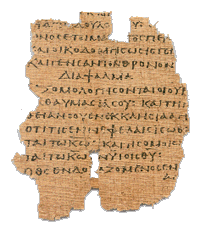
the one God & the other gods /

Η Εβδομήκοντα,
ο ένας Θεός και οι άλλοι θεοί


Θεοὺς οὐ κακολογήσεις
καὶ ἄρχοντα τοῦ λαοῦ σου οὐ κακῶς ἐρεῖς.

You shall not revile gods,
and you shall not speak ill of your people's rulers.


Έξοδος 22:28, O' / Exodus 22:28, NETS


The most important theological point that is conveyed by the Shema' and the Ten Commandments is that Israel should worship only the one true God. Originally, the commandment to worship only the God of Israel did not constitute a denial that there were other gods. By our period, however, Jews had come to the view that the other gods were not real gods. In technical terms, Judaism progressed from henotheism (our God is God number one) and monolatry (we worship him alone) to monotheism (our God is the only real God; him alone we worship).

The first of the Ten Commandments forbids the worship of other gods, the
second the making of'graven images', or, indeed, 'any likeness of anything that is in heaven above, or that is in the earth beneath, or that is in the water under the earth' (Ex. 20.3-4; Deut. 5.7-8). The Shema' specifies that the Lord God is one, which in the first century implied strict monotheism: the one Lord is the only Lord. Jewish sensitivity to these commandments was high.

Sensitivity increased as one got closer to the temple. The world was densely
populated with statues of various gods, and Jews did not go around the world trying to pull them down. Fortunately, the translators of the Septuagint provided Greek-speaking Jews with a biblical justification for tolerance of Gentile gods. The Hebrew of Ex. 22.27 means 'you shall not revile God', but 'God' is plural, as is usually the case: Hebrew distinguished the God of Israel from any other god by using the plural for the singular Israelite deity. In this particular verse (LXX and ET 22.28), the Septuagint kept the plural, so that in Greek the commandment read, 'you shall not revile the gods'. Both Philo and Josephus interpreted this to mean that Jews were forbidden to blaspheme other people's gods, and Josephus extended the law, so that it prohibited them from robbing foreign temples and taking treasure (for example, in war) that had been dedicated to other gods. Philo also construed Lev. 24.15 (do not curse God) to mean do not curse the gods of the cities. Jews tolerated temples built for other gods, both outside Palestine and in the cities of Palestine where Gentiles lived (e.g. Caesarea).

* E. P. Sanders,
Judaism: Practice and Belief, 63 BCE-66 CE
[Ιουδαϊσμός: Οι Πρακτικές και τα Πιστεύω, 63 ΠΚΧ-66 ΚΧ],
Trinity Press International; SCM Press, 1992,
p./σ. 242.


Saturday, November 12, 2011

Emperor Constantine’s
very mixed blessings /

Η πολύ ανάμεικτη ευλογία
του αυτοκράτορα Κωνσταντίνου


Flavius Valerius Aurelius Constantinus—commonly known as Constantine I—was emperor of Rome from 306 until his death in 337. The Orthodox Catholic Church recognizes Constantine as a saint, the Roman Catholic Church does not. While this reflects substantial differences in evaluation, both Eastern and Western Catholics have long esteemed the emperor’s contributions to the security, prosperity, and power of Christianity, and writers in both traditions routinely refer to him as “Constantine the Great.”

However in later, more skeptical centuries, many historians echoed the attack on Constantine made by the emperor Julian the Apostate (331–363) during his quixotic and brief effort to reestablish paganism: Julian denounced Constantine as an insincere and self-indulgent tyrant. Thus generations of scholars rejected the authenticity of Constantine’s conversion, dismissed his support of Christianity as cynical, and condemned the unity he attempted to impose on the church. A leading critic was Jacob Burckhardt (1818–1897), who wrote: “Attempts have been made to penetrate the religious consciousness of Constantine and to construct a hypothetical picture of the changes in his religious convictions. Such efforts are futile. In a genius driven without surcease by ambition and lust for power there can be no question of religiosity; such a man is essentially unreligious, even if he pictures himself standing in the midst of a churchly community.... [A]ll of his energies, spiritual as well as physical, are devoted to the great goal of domination.” Then Burckhardt summed up Constantine as “a calculating politician who shrewdly employed all available physical resources and spiritual powers to the end of maintaining himself and his rule.”

This chapter opens by noting the reasons why recent historians have returned to a more complimentary view of Constantine’s conversion and his commitment to Christianity. It then assesses the benefits Constantine heaped upon the church—his massive church-building program all across the empire, as well as the privileges and power he conferred upon the clergy. Then it will be seen that Constantine’s imposition of doctrinal unity on Christianity created a tradition of crushing dissent. Remarkably, all the while he led religious intolerance within Christianity, he extolled tolerance of paganism. Finally, Constantine’s embrace of Christianity was interpreted in Persia to mean that all local Christians were potential traitors during wars with the empire, thus initiating decades of bloody persecution.


* Rodney Stark,
The Triumph of Christianity: How the Jesus Movement Became the World's Largest Religion
[Ο Θρίαμβος του Χριστιανισμού: Πώς το Κίνημα του Ιησού Έγινε η Μεγαλύτερη Θρησκεία του Κόσμου],
HarperOne 2011,
p./σ. 169, 170.


Thursday, November 10, 2011

A very rare case
of vocalized Tetragrammaton יהוה
with the vowel points
of Adonai אדני (/a/-/o/-/a/)
#2 /

Μια πολύ σπάνια περίπτωση
φωνηεντισμένου Τετραγράμματου יהוה
με τα φωνηεντικά σημεία
του Αδονάι אדני (/a/-/o/-/a/)
# 2


MS Cambridge University Library, T-S A39.11 Β

[Thankful to the Syndics of Cambridge University Library
for granting permission to publish.]


* See also: / Βλέπε επίσης:


Variation within Ancient Hebrew /

Ποικιλομορφία εντός της Αρχαίας Εβραϊκής


* Gary A. Rendsburg,
"Ancient Hebrew Phonology"
[Φωνολογία της Αρχαίας Εβραϊκής],
in/στό:
Alan S. Kaye & Peter T. Daniels,
Phonologies of Asia and Africa Volume 1,
Eisenbrauns, 1997,
pp./σσ. 66, 67.
[English/Αγγλικά, PDF]


Udo Schnelle:

Jesus' proclaim of the Kingdom
in the current political environment /

Η διακύρυξη της Βασιλείας από τον Ιησού
εντός του σύγχρονου πολιτικού περιβάλλοντος


* Udo Schnelle,
Theology of the New Testament
[Η θεολογία της Καινής Διαθήκης],
Baker Academic, 2009,
pp./σσ. 90, 91.


Saturday, November 5, 2011

The Sentences of Sextus:
Don't look for God's name /

Σέξτου Γνώμαι:
Μην ψάχνεις το όνομα του Θεού


θεοῦ ὄνομα μὴ ζήτει, οὐ γὰρ εὑρήσεις· πᾶν τὸ ὀνομαζόμενον ὀνομάζεται ὑπὸ τοῦ κρείττονος, ἵνα τὸ μὲν καλῇ, τὸ δὲ ὑπακούῃ· τίς οὖν ὁ ὀνομάσας θεόν; θεὸς οὐκ ὄνομα θεοῦ, ἀλλὰ δόξα περὶ θεοῦ.

-Σέξτου Γνώμαι /
The Sentences of Sextus
* 28
(Henry Chadwick, 1959)


Βλέπε:
Ιωάννη Δαμασκηνού,
Ιερά παράλληλα, Ο.ιθ'.
(ex fragmenta e cod. Berol. B.N. gr. 46 [= parallela Rupefucaldina])
[Ελληνικά/Greek, PDF]


Στ. Παπαδόπουλος,
Πατρολογία
τ. Α' (1977), σ. 313.