.

Showing posts with label PIETERSMA. Show all posts

Sunday, September 29, 2013

New English Translation
of the Septuagint
(NETS)
Statement of Principles /

Μεταφραστικές αρχές
της NETS


Statement of Principles

1. The title of the projected work is A New English Translation of the Septuagint and the Other Old Greek Translations Traditionally included under that Title (herein abbreviated as NETS).

2. The International Organization for Septuagint and Cognate Studies (IOSCS) is the primary sponsoring organization for this project. Grant applications, preliminary and final publications, etc., will be prepared in the name of or on behalf of the IOSCS.

3. For the purposes of NETS, the term Septuagint is understood to be exemplified by, but not in all respects (e.g. exact text, detailed contents) congruent with, Alfred Rahlfs's Septuaginta (1935).

4. Translators will have native or close-to-native fluency in standard English.

5. NETS will normally translate the best available editions. Footnotes will indicate significant semantic departures from the base text.

6. NETS translators will seek to reflect the meaning of the Greek text in accordance with the ancient translator's perceived intent, and as occasioned by the ancient translator's linguistic approach, even when this policy may result in an unidiomatic (though grammatical) English rendering. Appropriate footnotes will inform the reader.

7. Since much of the Septuagint derives from the Hebrew Scriptures, it is important to reflect that dependence as consistently and comprehensively as possible for the English reader. For this reason, NETS consciously attempts to employ the wording and approach of a standard modern English translation of the Hebrew Bible in situations in which the Greek understands the Hebrew text in the same way as the English. The New Revised Standard Version (NRSV) has been chosen to provide this English base. Where the Greek does not correspond to the Hebrew as understood by the NRSV, translators will make every reasonable effort to represent the differences fully and accurately.

8. The target audience of NETS closely approximates that of the NRSV. Publication in both electronic and print formats is envisioned.

9. The organizational structure of the project will consist of (1) an administrative committee, and (2) a translation committee.

9.1 The president of IOSCS will chair the administrative committee and the Treasurer of IOSCS will serve as financial officer for NETS. Funds specifically raised or earmarked for NETS will be held and administered separately from general IOSCS revenues. The administrative committee will annually prepare an audited statement of NETS funds and submit it to the annual meeting of the IOSCS. Because NETS is primarily sponsored by the IOSCS, the IOSCS Executive Committee will play a major role in the administration of the NETS project.

9.2 The translation committee will be chaired by a member of IOSCS other than the President. The carrying out of this project will be entrusted to the translation committee. If the position of translation committee chair falls vacant, a new chair will be appointed by the IOSCS on the recommendation of the remaining members of the translation committee.

10. An advisory board of senior scholars not actively engaged in the project, whose advice may be sought when deemed appropriate, will be appointed jointly by the administrative and translation committees.


* Source: / Πηγή: Statement of Principles. *


Monday, September 19, 2011

G. Kilpatrick's review
of A. Pietersma "Kyrios or Tetragram" /

Κριτική του G. Kilpatrick
στο "Κύριος ή Τετραγράμματο" του A. Pietersma


A. Pietersma "Kyrios or Tetragram" (85-101) first sets out to reduce the number of instances of the tetragram in Jewish manuscripts of the Greek version. First he argues that we have to allow for the possibility that the tetragram represents an intrusion from the Hebrew wherever the manuscript concerned shows any correction from an Hebrew text. Thus Barthélemy's scroll of the Minor Prophets (8 Hev XII gr) shows corrections from an Hebrew text and so the presence of the tetragram in Hebrew characters may represent a correction from the Hebrew. The same may be argued for P. Fouad 266 (Rahlfs 848).

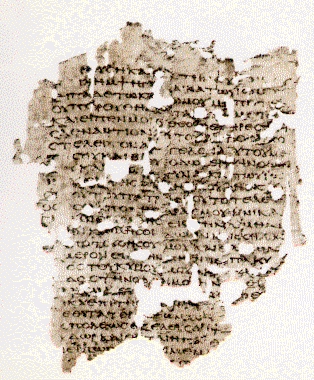
P.Ox.656
We may add a footnote here. P.Ox.656, Bodl. Gr. bibl. d.5(P), Rahlfs 905 has some variations where the tetragram is involved. An inspection of the papyrus suggests that 905 was copied from a text that had the tetragram in Hebrew letters. In copying the scribe of 905 left a space for the second scribe to insert the tetragram. Instead of doing this the second scribe inserted the corresponding forms of κύριος. Abbreviated κύριος does not always fit the space left by the first scribe and at least at one place (end of a line?) the second scribe has inserted nothing. If this correctly interprets the evidence of 905, it would support Koenen's view that the scribe of 848 left spaces in his transcript to be filled in by a second scribe.

We may question Pietersma's thesis that as far as 848 is concerned "its status, in general, as a typical exemplar of the LXX is not beyond doubt". This assumes that apart from demonstrable corrections the LXX was transmitted without interference from the Hebrew. We may question this assumption and argue that apart from other variations the LXX was frequently corrected from an Hebrew text whenever opportunity arose. If this is true, we cannot discard texts of the Greek version because they appear to show correction from the Hebrew. If this is so, we shall have to take 848's evidence seriously.

Let us assume that wherever papyri give the tetragram they are reproducing the LXX and that Origen is right in his evidence about the LXX on this point. We may suggest that apart from the Christian texts the LXX gave the tetragram either in archaic Hebrew or in Aramaic lettering. The occasional use of forms like ΙΑΩ or ΠΙΠΙ appear derivative.

Against this we have to set the facts of the Christian tradition. This consistently presents us with κύριος. How are we to explain this? Whatever was written in the manuscripts, we may infer that when the text was read aloud in the synagogue or elsewhere κύριος was used.

We may link this inference with another. In Vigiliae Christianae 36 (1982) 99-106 I reviewed C. H. Roberts, Manuscript, Society and Belief in Early Christian Egypt. Apart from other matters touched upon in Roberts' Schweich Lectures, we have conjectured that the difference between the script of manuscripts of Jewish origin and that of Christian texts may be explained as follows: "Up and down the eastern Mediterranean in the first century A.D. were many Greek-speaking Jewish communities. Each was centred in its synagogue whose congregation often seems to have consisted in a Jewish core and a fringe of interested Gentiles. From this Gentile fringe a number of converts passed into Judaism (Juvenal, Sat.xiv.96-106). When Christianity came upon the scene as in the missionary chapters of Acts it won over Jews and interested Gentiles, but the Jewish authorities controlling the synagogue seem to have remained unconvinced. If we may build on various hints in the Epistles, a minority of Jews and a majority of interested Gentiles seem to have joined the new movement. From this result we can infer that as the Jewish leadership rarely, if ever, became Christian, the resulting Christian community would not as a rule take over the official copies of the Greek Bible in all their calligraphy, but would have a number of private copies in a more or less workmanlike script which derived from the unofficial copies which members of the synagogue possessed." (100)

We may link this conjecture with another. Official manuscripts of the LXX may have had the tetragram, but unofficial and, subsequently, Christian texts, may have had κύριος. If this is true, Origen's statement is correct and the use of κύριος will by and large reflect private usage.

Pietersma later turns to the use of the article with κύριος. The principles followed in the Greek Pentateuch seem similar to those which obtain in large stretches of the New Testament, cf. my paper in P. Hoffmann (ed.), Orientierung an Jesus, Für Josef Schmid (1973) 214-219 "Κύριος Again". Variations in the NT manuscripts and problems in NT interpretation find helpful parallels in the LXX.

If we end by remaining unconvinced by Pietersma's arguments about the tetragram, we must none the less acknowledge that at many points he has made suggestions that are relevant to the NT. The form in which the LXX is quoted in the NT has its problems and Pietersma has indicated some of them in clear and detailed form.

* G.D. Kilpatrick,
Book Review of A. Pietersma's "Kyrios or Tetragram",
in A. Pietersma & C. Cox (edd.), De Septuaginta, Studies in Honour of John William Wevers on his sixj-fifth birthday [pp. xiv(?) + 261, Benben Publications, Mississauga, Ontario, Canada, 1984],
Novum Testamentum, Vol./Τόμ. 27, Nο/Αρ. 1-4, 1985, Brill,
pp./σσ. 380-382.

Sunday, July 4, 2010

A "controversial clue" & Albert Pietersma's unconvincing argument concerning the Tetragrammaton /
Το "διαμφισβητούμενο στοιχείο" & η μη πειστική επιχειρηματολογία του Άλμπερτ Πίτερσμα σχετικά με το Τετραγράμματο


«Origen maintained that, before the Christian era, when the LXX was a purely Jewish document, the divine name was rendered not by the Greek kurios (Lord) but rather by the Hebrew Tetragrammaton. This claim seems to make perfect sense, given the sanctity of the explicit Name and given that Aquila's translation, which was endorsed by the Rabbis, used the tetragram. Origen's view, however, was seriously challenged in 1929 with the publication of W. W. Graf von Baudissin's treatise "Kyrios als Gottesname im Judentum". According to Baudissin the LXX had rendered the divine name as kurios right from the beginning. Today, however, Baudissin's view is generally discarded, mainly because of the discovery of two crucial LXX fragments dating to pre-Christian times. The first is the so-called Fouad papyrus 266, made partially known in 1944. This papyrus dates back to the early first century BCE at the latest, and contains several chapters of Deuteronomy in Greek. The importance of this document is that every occurrence of the divine name is written with the Hebrew Tetragrammaton. In the older Rylands Papyrus 458 the divine name is not preserved. But Kahle concludes: "there can be no doubt that here in line 27 the divine name was written as Tetragrammaton with Hebrew letters and in this way completed the [damaged] line". The Judaean Desert findings brought a second new piece of evidence. In 1953, P. Barthélemy published an important paper in which a fragment of Habbakuk is reproduced from a Greek leather scroll. Although Barthélemy is interested in other aspects of what he calls "the missing link", one can quite clearly discern, after careful comparison with a modem LXX, that the penultimate line of the right-hand column contains 'Tetragrammaton ΩC". This is very fortunate, since the divine name does not appear very often in Habbakuk and the rest of the line is missing. In modern editions of the LXX this line is a part of verse 2:14, in which the name is given in the genitive case: "... kuriou hōs ...". Barthélemy himself adds in a footnote: "On notera ... I'ecriture du tétragramme en lettres 'phéniciennes'".

Although this evidence seems to destroy the very foundation on which Baudissin's theory might have relied, an incisive paper by Albert Pietersma is able to at least present a possible scenario whereby the fragments, being Palestinian rather than Egyptian recensions, represent an "archaizing tendency" in whose framework a "revisionary activity" took place at the time of the production of the oldest extant manuscripts of the LXX. Although Pietersma's argument is too lengthy to be reproduced here in full, one of its main thrusts relies on the use of oblique cases and articulation. To make this clear one must realize that, as a foreign linguistic element, the Tetragrammaton is indeclinable and thus, whenever the dative case was required, it would have had to be preceded by the dative article tō. Otherwise, the meaning of the text would have been ambiguous. Now, reasons Pietersma, if those dative occurrences of the Tetragrammaton had been systematically replaced later with kuriō (i.e., kurios in the dative case), the article would have stayed in most cases, so that the correspondence Lh = tō kuriō would have prevailed over Lh = kuriō, both grammatically correct. The fact is, however, that the opposite is true, namely, there is a much higher degree of occurrence for the second form than for the first. "Now, if we posit that the original LXX did not have kyrios but the indeclinable tetragram instead, we would have to believe that the kyrios surrogator ... hit on such a remarkable degree of correspondence." Concludes Pietersma in Holmesian style: "Impossible it is not, but certainly improbable."

If I understand Pietersma's argument correctly (it is more convoluted than my simplified explanation), I fail to be led to his conclusion. Why would it be improbable that the revisor would have decided in each case, according to context or personal taste, whether to leave out or to retain the article? The concept of probability is meaningless unless the rules of the game have been at least tentatively established. For all its brilliancy and excellent documentation, Pietersma's article is not convincing and the fact remains that, in his own words, "we have early, even pre-Christian, MS evidence for the tetragram and no such MS evidence to the contrary." Not all pre-Christian manuscripts use the Tetragrammaton. One of the Greek Leviticus fragments found in Qumran offers a phonetic transcription (iota, alpha, omega), thus raising the intriguing question as to the origin and pronunciation of the divine name, a topic beyond the limited scope of this work.»


* Marcelo Epstein,
«On the "original" Septuagint»
[«Σχετικά με την «αυθεντική» Εβδομήκοντα»],
The Bible translator, United Bible Societies,
July/Ιούλιος 1994 - Vol/Τόμ. 45, No/Αρ. 3,
pp./σσ. 327-329.

Image source / Πηγή εικόνας:
areopage.net