.

Showing posts with label ΠΟΛΕΜΟΣ ΚΑΙ ΣΤΡΑΤΟΣ. Show all posts

Tuesday, February 9, 2021

Ο Ιησούς ευλογεί
έφιππους στρατιώτες Ορθόδοξους αγίους /

Jesus blessing
the Greek Orthodox saints & cavalry soldiers


Μουσείο Μπενάκη: Eικόνα με τους έφιππους στρατιωτικούς αγίους Γεώργιο, Δημήτριο, Θεόδωρο Tήρωνα και Θεόδωρο Στρατηλάτη, μια θεαματική ενυπόγραφη δημιουργία του φημισμένου ζωγράφου Mιχαήλ Δαμασκηνού. Aπό τους σημαντικότερους εκπρόσωπους της Kρητικής Σχολής, ο Δαμασκηνός ανανέωσε το εκφραστικό λεξιλόγιο της μεταβυζαντινής ζωγραφικής κατά το δεύτερο μισό του 16ου αι.


Η Πρόεδρος της Δημοκρατίας σημείωσε πως η ξενάγησή της στη Δημοτική Πινακοθήκη και στην έκθεση με θέμα «Στρατιωτικοί Άγιοι του Βυζαντίου» της έφερε στο νου μια υποβλητική εικόνα του φημισμένου ζωγράφου Μιχαήλ Δαμασκηνού, που βρίσκεται στο Μουσείο Μπενάκη για την οποία είπε τα εξής: «Είναι μια ιδιαίτερα εκφραστική σύνθεση φιλοτεχνημένη με σχεδιαστική τόλμη και θερμή χρωματική παλέτα. Ο Δαμασκηνός παρουσιάζει τον Χριστό να ευλογεί τέσσερις στρατιωτικούς αγίους, που απεικονίζονται πάνω στα άλογά τους, κρατώντας στα χέρια τους το σύμβολο του μαρτυρίου τους, ατενίζοντας τους αγγέλους που κατέρχονται από τα νέφη για να τους στέψουν το “ουράνιο στέφος”. Ένας απ' αυτούς είναι ο Άγιος Δημήτριος, ο αθλοφόρος, αεικλεής και φιλόπολις, ο πολιούχος της Θεσσαλονίκης. Συγκαταλέγεται κι αυτός στους στρατιωτικούς, τροπαιοφόρους αγίους, που μαρτύρησαν για την πίστη τους, όπως ο Άγιος Γεώργιος, ο Θεόδωρος Τήρωνας και ο Θεόδωρος ο Στρατηλάτης, για να αναφέρω ενδεικτικά τους γνωστότερους, αλλά και μια γυναίκα, η Αγία Θεοδώρα της Βάστα, που μεταμφιέστηκε σε άντρα, πολέμησε σαν άντρας και σκοτώθηκε σαν άντρας. Η ρώμη, η γενναιότητα, η αυταπάρνηση αυτών των ένοπλων της εκκλησίας μας -416 στρατιωτικούς αγίους έχει μετρήσει ένας ερευνητής- συγκίνησαν βαθιά τους Χριστιανούς. Τους αγάπησαν σαν προστάτες και παράκλητους, σαν υπερασπιστές τους απέναντι στους αλλόπιστους εχθρούς, σαν παραστάτες στις δυσκολίες και τα δεινά των πολέμων και των καταστροφών. Τους ενσωμάτωσαν στη λαϊκή παράδοση, τους γιόρτασαν με πανηγύρια και λατρευτικά έθιμα, τους ιστόρησαν σε θρύλους στις κρίσιμες στιγμές των αγώνων των Ελλήνων για την ελευθερία. Τους απεικόνισαν έφιππους, με στρατιωτική περιβολή, με ραδινή κορμοστασιά, λογχοφόρους και δορυκρατούντες, δρακοντο-κτόνους και πολεμιστές, σύμβολα του σθένους απέναντι στο μαρτύριο και του θριάμβου πάνω στο θάνατο. Όλες οι εικόνες της έκθεσης αντανακλούν την αγάπη και το δέος που οδήγησαν τα πινέλα των αγιογράφων μας - κι αυτή ακριβώς η συναισθηματική σχέση ζωγράφου και απεικονιζόμενου αγίου πολλαπλασιάζει και τη συγκίνηση που αισθανόμαστε σήμερα μπροστά στις εικόνες της θαυμάσιας αυτής έκθεσης».

* Ναυτεμπορική, Κ. Σακελλαροπούλου: «H Θεσσαλονίκη σήμερα ξαναβρίσκει τον εξωστρεφή της χαρακτήρα», Τρίτη, 27 Οκτωβρίου 2020.


Wednesday, October 28, 2015

From the letters
of Patriarch Nicholas I Mysticos
to the Bulgar Czar Symeon
dealing with the wars
between the Byzantines
& the Bulgars (914–926)

Από τις επιστολές
του Πατριάρχη Νικολάου Α΄ του Μυστικού
προς τον Βούλγαρο Τσάρο Συμεών
αναφορικά με τους πολέμους
μεταξύ των Βυζαντινών
& των Βουλγάρων (914–926)


*

Κακοὶ γὰρ καὶ οἱ πρὸς τοὺς ἔξωθεν ἐχθροὺς πόλεμοι, ὅσοι δὲ πρὸς πατέρας, πρὸς ἀδελφούς, πρὸς φίλους, πρὸς ὁμοπίστους, πρὸς τοὺς ἕνα θεὸν ἐπιγραφομένους, ἕνα κύριον καὶ δεσπότην καὶ σωτῆρα, τί ἄν τις εἴποι;
—Νικόλαος Α' ο Μυστικός, Επιστολή 31.100-104.

Wars are bad even against outside enemies; but what shall one say of wars against fathers, brothers, friends, fellow-believers, who have chosen one God, one lord and Master and Saviour?
—Nicholas Mystikos, Epistle 31.100-104.


Ὅταν δὲ οἱ σφάζοντες καὶ σφαζόμενοι οὐ μόνον καθ’ ὃν εἴπομεν λόγον ἔχουσι κοινωνίαν, ἀλλὰ καὶ πατέρες τυγχάνωσιν καὶ τέκνα καὶ ἀδελφοί, ναὶ δὴ καὶ κληρονομία τοῦ Χριστοῦ καὶ θεοῦ ἡμῶν τοῦ τὸ αἷμα τῆς ἁγίας αὐτοῦ πλευρᾶς τὸ ἀσύγκριτον τοῦτο τίμημα δεδωκότος, ἵνα ἡμᾶς ἐξωνήσηται καὶ κλῆρον οἰκεῖον ἀποδείξῃ· ὅταν οὗτοι κατ’ ἀλλήλων ὁπλίζωνται, ὅταν τὴν γῆν καὶ τὰς χεῖρας μιαίνωσι ταῖς σφαγαῖς, τί ἄν τις εἴποι;
—Νικόλαος Α' ο Μυστικός, Επιστολή 17.41-47.

But when slaughterers and slaughtered are partners not only in the way I have described, but are fathers and sons and brothers of one another, yea, and the Inheritance of Christ our God, Who has paid the price of the Blood of his holy Side (this incomparable benefit), that he might redeem us and make us his one Portion–when these people arm themselves against one another, and pollute the earth and their hands with slaughter, then what can one say?
—Nicholas Mystikos, Epistle 17.41-47.

* Ioannis Stouraitis,
“Byzantine War against Christians—An emphylios polemos?”,
Byzantina Symmeikta 20 (2010).
[English/Αγγλικά, PDF]

Monday, June 22, 2015

Peter Meinhold
on early Christians' view
of joining the army /

Ο Πέτερ Μάινχολτ
περί της πρωτοχριστιανικής άποψης
για την κατάταξη στον στρατό


“Es ist deshalb verständlich, daß man auch auf dem Boden
der Alten Kirche zahlreiche Aussagen findet,
die eindeutig die Unvereinbarkeit des Christ- und Soldatseins feststellen.”

“...it was considered irreconcilability being a Christian and a soldier.”

«...θεωρούνταν ασυμβίβαστο το να είναι κάποιος χριστιανός και στρατιώτης».


* Peter Meinhold,
Römer 13: Obrigkeit, Wilderstand, Revolution, Krieg,
Stuttgart: Kreuz-Verlag, 1960,
p./σ. 127.


Saturday, May 2, 2015

Ο Ωριγένης
& η «άλλη» πατρίδα των χριστιανών /

Origen
& the "other" country of the Christians


*

Προτρέπει δ' ἡμᾶς Κέλσος καὶ ἐπὶ τὸ ἄρχειν τῆς πατρίδος, ἐὰν δέῃ καὶ τοῦτο ποιεῖν ἕνεκεν σωτηρίας νόμων καὶ εὐσεβείας. Ἡμεῖς δὲ ἐν ἑκάστῃ πόλει ἄλλο σύστημα πατρίδος κτισθὲν λόγῳ θεοῦ ἐπιστάμενοι τοὺς δυνατοὺς λόγῳ καὶ βίῳ ὑγιεῖ χρωμένους ἄρχειν ἐπὶ τὸ ἄρχειν ἐκκλησιῶν παρακαλοῦμεν, οὐκ ἀποδεχόμενοι μὲν τοὺς φιλάρχους βιαζόμενοι δὲ τοὺς διὰ πολλὴν μετριότητα τὴν κοινὴν φροντίδα τῆς ἐκκλησίας τοῦ θεοῦ μὴ βουλομένους προπετῶς ἀναδέξασθαι· καὶ οἱ καλῶς ἄρχοντες ἡμῶν βιασθέντες ὑπάρχουσι, τοῦ μεγάλου βασιλέως ἀναγκάζοντος, ὃν πεπείσμεθα εἶναι υἱὸν θεοῦ λόγον θεόν. Καὶ εἰ ἄρχουσιν καλῶς οἱ ἄρχοντες ἐν τῇ ἐκκλησίᾳ τῆς κατὰ θεὸν πατρίδος –λέγω δὲ τῆς ἐκκλησίας– , λεγόμενοι ἢ <βιαζόμενοι>, καὶ ἄρχουσι κατὰ τὰ ὑπὸ τοῦ θεοῦ προστεταγμένα, οὐδὲν παρὰ τοῦτο μολύνοντες τῶν θεῶν νόμων.

Celsus exhorts us also to accept public office in our country if it is necessary to do this for the sake of the preservation of the laws and of piety. But we know of the existence in each city of another sort of country, created by the Logos of God. And we call upon those who are competent to take office, who are sound in doctrine and life, to rule over the churches. We do not accept those who love power. But we put pressure on those who on account of their great humility are reluctant hastily to take upon themselves the common responsibility of the church of God. And those who rule us well are those who have had to be forced to take office, being constrained by the great King who, we are convinced, is the Son of God, the divine Logos. Even if it is power over God's country (I mean the Church) which is exercised by those who hold office well in the Church, we say that their rule is in accordance with God's prior authority, and they do not thereby defile the appointed laws.


* Origen, Contra Celsum 8:75 (transl. H. Chadwick) /
Ωριγένης, Κατά Κέλσου 8:75.

*


Monday, February 24, 2014

עַד-אָנָה יְהוָה


#


:עַד-אָנָה יְהוָה שִׁוַּעְתִּי, וְלֹא תִשְׁמָע
.אֶזְעַק אֵלֶיךָ .חָמָס, וְלֹא תוֹשִׁיעַ

Habakkuk 1:2


Monday, December 16, 2013

Jesus
blessing the Russian army /

Ο Ιησούς
ευλογεί τον ρωσικό στρατό


Emperor of Russia Nicholas II (1868–1918)
blessing the army officers with a sacred icon,
September 1917 /

Ο αυτοκράτορας Νικόλαος Β΄ της Ρωσίας (1868–1918)
ευλογεί αξιωματικούς του στρατού με μια ιερή εικόνα
τον Σεπτέμβριο του 1917


* * *
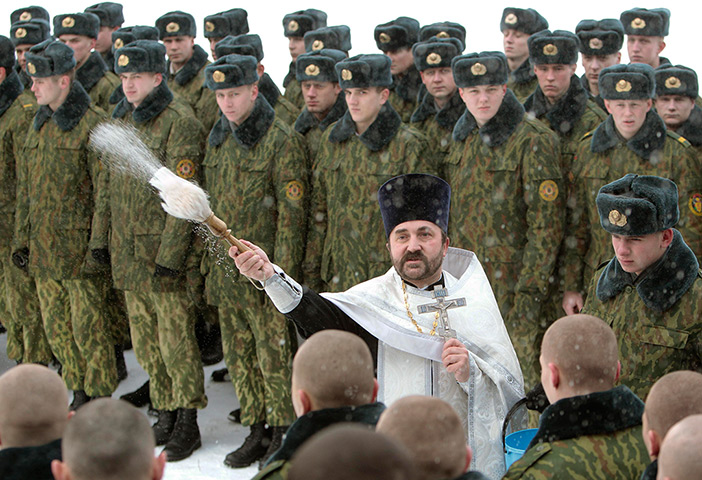
Minsk, Belarus:
An Orthodox priest blesses servicemen
from the Belarussian interior ministry's special unit
during a service at a military base


Thursday, June 6, 2013

Όταν φοράνε
τα ρούχα του πολέμου
στο βιβλίο της ειρήνης /

Wearing the army uniform
to the book of peace


Τα χακί «φόρεσε» το ιερό βιβλίο της Αγίας Γραφής προκειμένου να διανεμηθεί από τον Μητροπολίτη Αλεξανδρουπόλεως κ. Άνθιμο σε στρατιώτες που υπηρετούν σε σχηματισμούς της περιοχής.

Η διανομή ξεκίνησε χθες από τον Μητροπολίτη κ. Άνθιμο και θα ολοκληρωθεί αύριο. Συνολικά 1800 αντίτυπα της Αγίας Γραφής με το εξώφυλλο της σε στρατιωτική παραλλαγή μοιράζει ο Μητροπολίτης κ. Άνθιμος.

Οι σχηματισμοί στους οποίους γίνεται η διανομή είναι: η 12η Μ/Κ Μεραρχία Πεζικού «Έβρου», η 23η Τ/Θ Ταξιαρχία στην Αλεξανδρούπολη, η 31η Μ/Κ Ταξιαρχία «Κάμια» στις Φέρες και η 7η Μ/Κ Ταξιαρχία στον Προβατώνα.

Απευθυνόμενος στους αξιωματικούς και τους οπλίτες ο κ. Άνθιμος μίλησε «για την σημασία και την αξία της Καινής Διαθήκης, κυρίως στην εποχή μας, όπου τα πάντα κλονίζονται και αποσταθεροποιούνται, ενώ ο Λόγος του Θεού μένει ζωντανός και δυναμικός, ικανός να στηρίξει, να ενισχύσει και να εμπνεύσει τους νέους ανθρώπους και την κοινωνία».

Τα βιβλία της Αγίας Γραφής είναι μια προσφορά της Ελληνικής Βιβλικής Εταιρείας.


* Δόγμα.gr,
«Η Αγία Γραφή "ντύθηκε" στα χακί»,
5 Ιουνίου 2013.


Tuesday, April 30, 2013

Should Christians
join the army? /

Πρέπει οι χριστιανοί
να στρατεύονται;


Greek Orthodox Christian Chaplain
of the II Infantry Division in the Balkan Wars
and WWI, Fr. Eleutherios Nuphrákes
Greek Orthodox Christian Chaplains
during the Balkan Wars
Greek Orthodox Christian Chaplain
during the Balkan Wars
Greek Orthodox Christian Chaplain
in Albania during WWII


Christianity

The controversy over whether Christianity sanctions violence has hounded the church from its very beginning. Some have argued that Christians were expected to follow Jesus' example of selfless love (agape), and "love your enemies and pray for those who persecute you" (Matt. 5: 44). Those who took the other side have referred to the incident in which Jesus drove the money changers from the Temple, and to his enigmatic statement: "Do not think that I have come to bring peace on earth; I have not come to bring peace but a sword" (Matt. 10:34; cf. also Luke 12:51-2). The early Church Fathers, including Tertullian and Origcn, asserted that Christians were constrained from taking human life, a principle that prevented Christians from serving in the Roman army.

When Christianity was vaulted into the status of state religion by Constantine in the fourth century CE, it began to reject pacifism and accept the doctrine of just war, an idea first stated by Cicero and later developed by Ambrose and Augustine. The abuse of the concept in justifying military adventures and violent persecutions of heretical and minority groups led Thomas Aquinas, in the thirteenth century, to reaffirm that war is always sinful, even if it is occasionally waged for a just cause. Remarkably, the just war theory still stands today as the centerpiece of Christian understanding about the moral use of violence (see, e.g., Ramsay 1968; Potter 1969). Some Christian theologians have adapted the theory of just war to liberation theology, arguing that the church can embrace a "just revolution" (Brown 1987; Gutierrez 1988).

An American Protestant theologian, Reinhold Niebuhr, showed the relevance of the just war theory to contemporary social struggles by relating it to the Christian requirement to fulfill social justice. When violence is employed for the sake of justice, Niebuhr explained, it must be used as swiftly and skillfully "as a surgeon's knife" (Niebuhr 1932:134). In a famous essay answering the question, "why the Christian Church is not pacifist", Niebuhr—who had himself been a pacifist earlier in his career—built his case on Augustine's understanding of original sin. Because of the sinful nature of humanity, Niebuhr argued, righteous force was sometimes necessary to extirpate injustice and subdue evil within a sinful world (Niebuhr 1940).


«Οι πρώτοι εκκλησιαστικοί πατέρες, περιλαμβανομένου του Τερτυλλιανού και του Ωριγένη, δήλωναν ότι απαγορευόταν στους Χριστιανούς να αφαιρέσουν ανθρώπινη ζωή, μια αρχή που τους εμπόδιζε να συμμετέχουν στο ρωμαϊκό στρατό».

* The Oxford Handbook of the Sociology of Religion,
Peter Bernard Clarke (ed.),
Oxford Handbooks Online, 2008,
p./σ. 899.


*   *

Monday, April 29, 2013

Early & modern Christian positions
on the question of war /

Στάσεις απέναντι στο ζήτημα του πολέμου
των πρώτων και των σύγχρονων χριστιανών


What caused the mission of Greek Orthodox Church to Korea? /
Ποια ήταν η αιτία της ιεραποστολής στην Κορέα
από την Ορθόδοξη Εκκλησία της Ελλάδος;

"Archimandrite Hariton Symeonides of the Greek Orthodox Church -
Holy Water Blessing with Greek Soldiers during the Korean War.
Archimandrite Hariton was the first Greek Chaplain to come in contact with the Korean Orthodox
whom were scattered throughout Korea due to the War. He worked to gather the flock in 1951." * * 


'Orthodox priests sprinkled holy water on nuclear warheads and blessed military factories,
navy vessels and army aeroplanes while mugging for cameras.' *


"NONVIOLENCE. Virtually every religious tradition contains some sort of injunction against taking human life. The biblical instruction “Thou shalt not kill” (Ex. 20:13, Dt. 5:17), considered normative for both Jewish and Christian traditions, is echoed in the New Testament (Mt. 5:21) and also in the Quran: “Slay not the life that God has made sacred” (6:152). In the Buddhist tradition, the first of the Five Precepts mandated as part of the Eightfold Path of righteous living is the requirement not to kill. A Jain text claims that “if someone kills living things . . . his sin increases” (Sutrakratanga 1.1), a sentiment that is also found in Hinduism: “The killing of living beings is not conducive to heaven” (Manusmrti 5.48).

[...]

EARLY CHRISTIANITY. Martyrdom was an important feature of early Christianity as well, partly because it seemed an imitation of the sacrifice of Jesus, but there has been disagreement among Christians from that time to the present over whether Jesus’ example of selfless love (agape) was meant to be followed to similar extremes by other members of the Christian community. Those who thought so expected that the peaceable kingdom of God that is often depicted in the Gospels would be realized in this world, and they took literally Jesus’ advocacy of a nonviolent approach to conflict: “Love your enemies and pray for those who persecute you” (Mt. 5:44).

The early church fathers, including Tertullian and Origen, affirmed that Christians were constrained from taking human life, a principle that prevented them from participating in the Roman army. The fact that soldiers in the army were required to swear allegiance to the emperor’s god was also a deterrent, since it would have forced Christians into what they regarded as idolatry.

The adoption of Christianity as the state religion by Constantine in the fourth century CE brought about a major reversal in Christian attitudes toward pacifism and led to the formulation of the doctrine of just war. This idea, based on a concept stated by Cicero and developed by Ambrose and Augustine, has had a significant influence on Christian social thought. The abuse of the concept in justifying military adventures and violent persecutions of heretical and minority groups led Thomas Aquinas, in the thirteenth century, to reaffirm that war is always sinful, even if it is occasionally waged for a just cause.

PACIFIST CHRISTIAN MOVEMENTS.
The late medieval period witnessed the rise of a series of movements dedicated to pacifism and the ethic of love that Jesus had advocated in his Sermon on the Mount. One of the first of such groups was the Waldensian community based in France and North Italy; this was founded by Pierre Valdès, who in 1170 had committed himself to a life of poverty and simplicity, and who refused to bear arms. Although Valdès was excommunicated from the church, he is said to have influenced the young Francis of Assisi, whose religious order later adopted many of Valdès’s principles. Similar pacifist teachings were advocated by John Wyclif and his Lollard followers in fourteenthcentury England, and in the same century the Hussite and Taborite movements in Czechoslovakia rejected all forms of violence, as did their successors, the Moravians.

The Protestant Reformation provided a new stimulus for groups that rejected the church’s compromise with what it often regarded as the political necessity of military force. In the first decades of the sixteenth century, the Anabaptists broke away from Ulrich Zwingli’s branch of the Swiss Reformation over the issues of voluntary baptism and absolute pacifism—teachings the Anabaptists affirmed and that, later in the same century, were adopted by Menno Simons and his Mennonite followers in Holland. In a tragic and ironic twist of fate, many of these pacifists were persecuted by fellow Protestants as heretics, and were burned at the stake.

Perhaps the best-known Protestant pacifist movement is the Society of Friends, commonly known as the Quakers, which was established by George Fox in England in 1649. The nonviolent ethic of this radical Puritan movement was based on the notion that a spark of the divine exists in every person, making every life sacred. With this in mind, the Quaker colonialist William Penn refused to bear arms in his conflict with the American Indians, with whom he eventually negotiated a peace settlement.

Many pacifist Christian movements in the nineteenth and twentieth centuries, such as the Jehovah’s Witnesses, owe a substantial debt to Christian predecessors such as those mentioned above. Others have been influenced by Western humanist and Asian pacifist thought, especially, in the twentieth century, by the ideas of Mohandas Gandhi. Gandhi, in turn, was influenced by Christian pacifists, including the Russian novelist and visionary Lev Tolstoi and the American Christian social activists Kirby Page, Clarence Marsh Case, and A. J. Muste. The largest Christian pacifist organization of modern times, the Fellowship of Reconciliation, was founded in England in 1914; and a number of statements urging nonviolence have been issued from the Vatican and from the World Council of Churches in response to the two world wars of this century. In the United States during the mid-twentieth century, Christian pacifist ideas played a significant role in Martin Luther King, Jr.’s nonviolent movement for racial justice, the movement against the American involvement in the Vietnam War, and in movements against the proliferation of nuclear weapons. Some Christian “nuclear pacifists,” however, restrict their advocacy of nonviolence to nuclear arms, whose massively destructive power, they feel, vitiates the traditional Christian defense of weaponry in a “just war.”"


«Οι πρώτοι εκκλησιαστικοί πατέρες, περιλαμβανομένου του Τερτυλλιανού και του Ωριγένη, δήλωναν ότι απαγορευόταν στους Χριστιανούς να αφαιρέσουν ανθρώπινη ζωή, μια αρχή που τους εμπόδιζε να συμμετέχουν στο ρωμαϊκό στρατό».


* The Encyclopedia of Religion
[Εγκυκλοπαίδεια της Θρησκείας],
2nd ed., Macmillan Reference/Thomson Gale 2005,
vol./τόμ. 10, p./σ. 6647, 6648.